
Recent Talks and Professional Training

Agitation is a common but challenging symptom in dementia, often arising from unmet needs or environmental triggers. This session provides insights into the causes of agitation, alongside effective behavioral techniques to reduce stress and promote calm. Attendees will leave equipped with practical skills to manage agitation compassionately and create a more supportive environment for their clients.

Psychosis, a lesser-known symptom of dementia, can be deeply distressing for both the affected individual and their caregivers. This session delves into the causes and types of dementia-related psychosis, offering insights into compassionate management strategies. Learn effective behavioral and communication techniques to support clients experiencing delusions or hallucinations and improve overall care approaches.

Memory loss and cognitive impairment are often the first signs of dementia, but understanding their nuances can make a significant difference in care. This session provides essential knowledge about the causes and types of cognitive decline, along with practical techniques to manage and support those affected by memory and cognitive issues. Attendees will learn behavioral strategies to help individuals navigate cognitive impairment and enhance quality of life.

Learn how neuropsychology can benefit social services, as well as how to get the most out of an assessment.

In this training we will explore what cognitive impairment truly means, how dementia affects communication, and how Ombudsman can adjust their approach to improve clarity, trust, and outcomes.

Huntington’s Dementia stems from a genetic condition that affects motor skills, cognition, and emotions. This session covers the unique challenges of Huntington’s, its progression, treatments, and strategies for caregivers to provide supportive care.


Agitation is a common but challenging symptom in dementia, often arising from unmet needs or environmental triggers. This session provides insights into the causes of agitation, alongside effective behavioral techniques to reduce stress and promote calm. Attendees will leave equipped with practical skills to manage agitation compassionately and create a more supportive environment for their clients.
Agitation is a common but challenging symptom in dementia, often arising from unmet needs or environmental triggers. This session provides insights into the causes of agitation, alongside effective behavioral techniques to reduce stress and promote calm. Attendees will leave equipped with practical skills to manage agitation compassionately and create a more supportive environment for their clients.

Substance use can cause long-term cognitive damage, resulting in dementia-like symptoms. This session highlights the behavioral and cognitive impacts of substance use-related dementias, their course, treatments, and strategies for managing challenging behaviors.

Aphasia, the loss of language ability, poses unique challenges in dementia care. This training equips attendees with the tools to understand aphasia’s impact and how best to communicate with those affected. Through real-world examples and practice-based techniques, attendees will learn how to bridge communication gaps, reduce frustration, and foster meaningful connections.

Vascular dementia results from reduced blood flow to the brain, leading to cognitive and behavioral symptoms. This session discusses the varying presentations of vascular dementia, its progression, medical management, and behavioral strategies to enhance quality of life.
Aphasia, the loss of language ability, poses unique challenges in dementia care. This training equips attendees with the tools to understand aphasia’s impact and how best to communicate with those affected. Through real-world examples and practice-based techniques, attendees will learn how to bridge communication gaps, reduce frustration, and foster meaningful connections.


Parkinson’s Dementia and Lewy Body Dementia are overlapping conditions but also present unique challenges, including visual hallucinations and movement difficulties. This session examines their behavioral and cognitive symptoms, progression, treatments, and supportive care strategies.
Agitation is a common but challenging symptom in dementia, often arising from unmet needs or environmental triggers. This session provides insights into the causes of agitation, alongside effective behavioral techniques to reduce stress and promote calm. Attendees will leave equipped with practical skills to manage agitation compassionately and create a more supportive environment for their clients.

Aphasia, the loss of language ability, poses unique challenges in dementia care. This training equips attendees with the tools to understand aphasia’s impact and how best to communicate with those affected. Through real-world examples and practice-based techniques, attendees will learn how to bridge communication gaps, reduce frustration, and foster meaningful connections.

Frontotemporal Dementia (FTD) and its subtypes including Primary Progressive Aphasia (PPA) affect behavior, emotions, and language, often disrupting interpersonal relationships. This session provides an overview of these conditions, their course, treatment options, and practical strategies for managing challenges associated with these conditions.
Psychosis, a lesser-known symptom of dementia, can be deeply distressing for both the affected individual and their caregivers. This session delves into the causes and types of dementia-related psychosis, offering insights into compassionate management strategies. Learn effective behavioral and communication techniques to support clients experiencing delusions or hallucinations and improve overall care approaches.
Memory loss and cognitive impairment are often the first signs of dementia, but understanding their nuances can make a significant difference in care. This session provides essential knowledge about the causes and types of cognitive decline, along with practical techniques to manage and support those affected by memory and cognitive issues. Attendees will learn behavioral strategies to help individuals navigate cognitive impairment and enhance quality of life.


As we age our bodies and brains start to slow down. Erik Lande, Ph.D from Insight Neuropsychology will focus on how to promote healthy brain functioning, especially memory. Explore lifestyle choices and cognitive strategies that can keep us thinking strong.


We will explore effective interventions and approach styles for staff as they work with older adults who may be making unsafe or unwise choices.

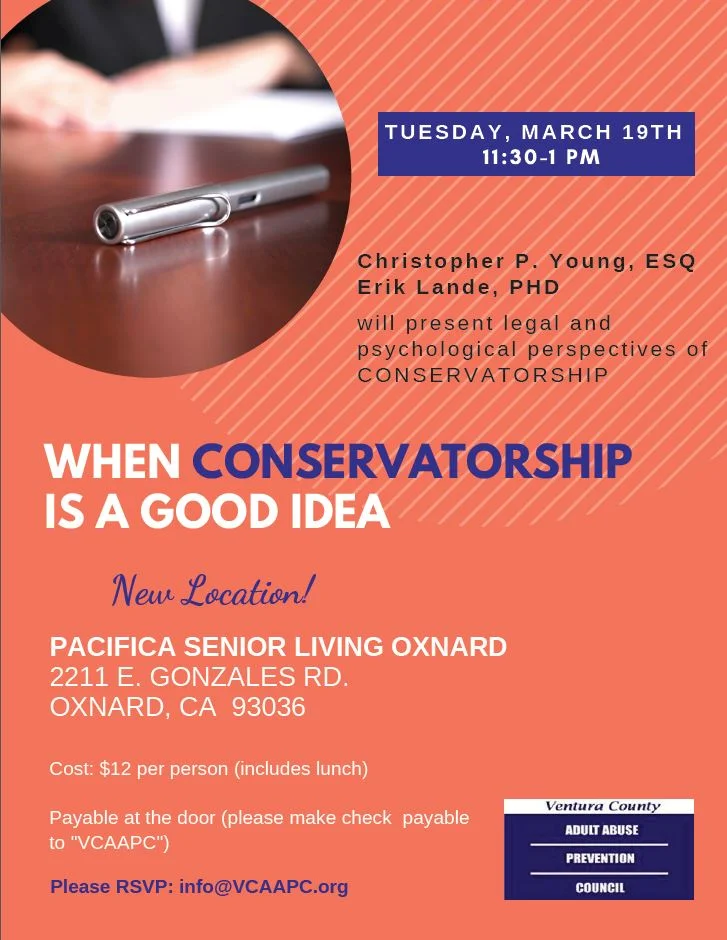

The United States Attorney’s Office for the Central District of California in partnership with the Federal Bureau of Investigation and the South Pasadena Police Department will present a one day training on strategies to prevent and investigate elder fraud. Participants will learn:
Innovative techniques and strategies for effective investigations of transnational and other scams targeting older adults, including;
Romance, Lottery, IRS, Tech Support and "Grandparent Scams".
Best practices and interviewing techniques for understanding, engaging, and interviewing older adult victims of crime.
Learn about new investigative tools and resources to facilitate information-sharing between local, state and federal law enforcement.

Understand of the cognitive, emotional, and behavioral difficulties that can accompany dementia. We will explore some of the stresses caregivers and families experience and how to assist with this. And because none of us are getting any younger, some personal health strategies to help each of us maintain a healthy brain will be offered.
This will be part of the 40 hour crisis intervention training (CIT) workshop provided to certify Ventura County law enforcement personnel. We will explore what dementia is, the different types of dementia, and behavioral difficulties encountered with dementia. Appropriate interventions and responses will also be covered.

As we age our bodies and brains start to slow down. Erik Lande, Ph.D from Insight Neuropsychology will focus on how to promote healthy brain functioning, especially memory. Explore lifestyle choices and cognitive strategies that can keep us thinking strong.
As we age our bodies and brains start to slow down. Erik Lande, Ph.D from Insight Neuropsychology will focus on how to promote healthy brain functioning, especially memory. Explore lifestyle choices and cognitive strategies that can keep us thinking strong.
This will be part of the 40 hour crisis intervention training (CIT) workshop provided to certify Ventura County law enforcement personnel. We will explore what dementia is, the different types of dementia, and behavioral difficulties encountered with dementia. Appropriate interventions and responses will also be covered.

Understand of the cognitive, emotional, and behavioral difficulties that can accompany dementia. We will explore some of the stresses caregivers and families experience and how to assist with this. And because none of us are getting any younger, some personal health strategies to help each of us maintain a healthy brain will be offered.
In this workshop, we will provide an overview of different types of dementia and their prevalence, practice in administering a basic screening measure of dementia, and an explanation of how neuropsychological assessment can improve diagnostic clarity and inform intervention efforts. A focus of this workshop will be on practical strategies of observation and intervention across the disease process.
We will explore how normal age-related brain changes can cause a senior to be more susceptible to financial scams and exploitation. We will explore relevant clinical and practical research and discuss how this differs from financial problems seen in dementia. Strategies for identifying problems with financial capacity and for supporting seniors will be discussed. Maintaining a senior’s independence as much as possible will be emphasized.
In this workshop we will provide an overview of our multidisciplinary model, discuss its development, stakeholders, roles, and responsibilities, and present initial data, including that on client referral problems, mental health diagnoses and assessment data, APS interventions, and outcomes, which were collected throughout the span of the APS and neuropsychological process. A focus of this workshop will be on the specialized role of psychologists and the utility of neuropsychological assessment data to other professionals and the integrated multidisciplinary model.

We will explore effective interventions and approach styles for staff as they work with older adults who may be making unsafe or unwise choices.
Understand of the cognitive, emotional, and behavioral difficulties that can accompany dementia. We will explore some of the stresses caregivers and families experience and how to assist with this. And because none of us are getting any younger, some personal health strategies to help each of us maintain a healthy brain will be offered.

Understand of the cognitive, emotional, and behavioral difficulties that can accompany dementia. We will explore some of the stresses caregivers and families experience and how to assist with this. And because none of us are getting any younger, some personal health strategies to help each of us maintain a healthy brain will be offered.

Training focusing on the aging brain and the use of mindfulness and learning interventions in the classroom.

Training focusing on the aging brain and the use of mindfulness and learning interventions in the classroom.


